Showing posts with label John Baptist. Show all posts

Friday, August 29, 2008

Malta Memory


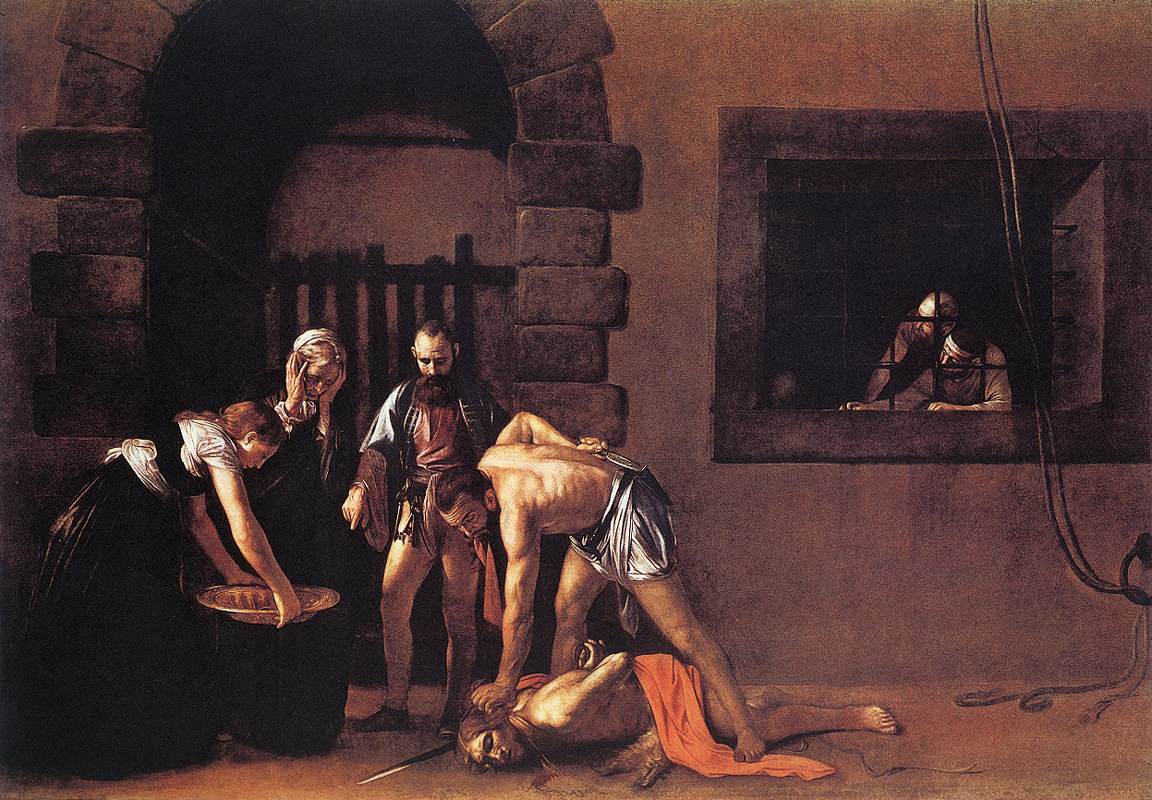
Beheading of Saint John the Baptist 1608
Oil on canvas, 361 x 520 cm
Saint John Museum, La Valletta

This is the most important painting that Caravaggio made in Malta. It is still in the Oratorio di San Giovanni (now St John Museum) in La Valletta. This is one of Caravaggio's most extraordinary creations, for many it is his greatest masterpiece. It is characterized by a magical balance of all the parts. It is no accident that the artist brings back into the painting a precise reference to the setting, placing behind the figures, as a backdrop, the severe, sixteenth century architecture of the prison building, at the window of which, in a stroke of genius, two figures silently witness the scene (the commentators are thus drawn into the painting, and no longer projected, as in the Martyrdom of St Matthew, toward the outside).

This is a final compendium of Caravaggio's art. Well-known figures return (the old woman, the youth, the nude ruffian, the bearded nobleman), as do Lombard elements. The technical means adhere to the deliberate, programmatic limitation to which Caravaggio adapts them; but amid these soft tones, these dark colours, is an impressive sense of drawing that the artist does not give up, and that is visible even through the synoptic glints of light of his late works. This eminently classical balance, which projects the event beyond contingency, unleashes a harsh drama that is even more effective to the extent that, having given up the "aesthetic of exclamation" forever, Caravaggio limits every external, excessive sign of emotional emphasis.
The painter signed in the Baptist's blood: "f (perhaps to understood as fecit rather than frater) michela...". This is the seal he placed on what may well be his greatest masterpiece.
Beheading of St John the Baptist

Considered by many to be the artist Caravaggio’s greatest work, ‘The Beheading of St John the Baptist’ is housed in St John’s Co-Cathedral of La Valletta in Malta. In this painting the artist captures both the brutality of the execution of St John the Baptist and the sanctity and holiness of the man who proclaimed, ‘Behold, the Lamb of God, who takes away the sin of the world’ (John 1:29), only to become himself a lamb led to the slaughter.
Today we remember one of Christendom’s greatest saints and martyrs and celebrate his life and witness which speaks so eloquently of one who was called to pay the ultimate price for his faith.
From its very beginning the Church has had a special devotion to St John the Baptist. His courage and conviction rings out to every generation, proclaiming that if we want to follow Christ, we need to be prepared to come and die with him that we may be raised with him to new life. John the Baptist can be seen as on the cusp of the Old Testament and the New. The Lord himself bore witness to this when he said that ‘the prophets and the law prophesied until John’ (Matt. 11:13). Thus he represents times past and is the herald of the new era to come. As a representative of the past, he is born of aged parents; as a herald of the new era, he is declared to be a prophet and, while yet unborn, leaps in his mother’s womb at the arrival of blessed Mary. The angel who foretells his birth reveals that John is to be Christ’s precursor, preparing the people to receive him (Luke 1:16-17). These are divine happenings, going beyond the limits of our human frailty. While preaching about the Lord’s coming in the desert, John the Baptist was asked, ‘Who are you?’ He replied: ‘I am the voice of one crying in the wilderness’ (John 1:23). We can compare John the Baptist’s description of himself as a ‘voice’ with St John’s description of Jesus Christ as ‘the Word’ (John 1:1).
John was a voice that lasted only for a time; Christ, the Word from the beginning, is eternal.
‘Lord Jesus, may I decrease and may you increase. May I by God’s grace give witness to the gospel with the same courage and conviction that St John the Baptist showed.’

Sunday, June 24, 2007

Six months to Christmas

Luke 1:57-80
The Birth of John the Baptist


57 Now the time came for Elizabeth to give birth, and she bore a son. 58Her neighbours and relatives heard that the Lord had shown his great mercy to her, and they rejoiced with her.
59 On the eighth day they came to circumcise the child, and they were going to name him Zechariah after his father. 60But his mother said, ‘No; he is to be called John.’ 61They said to her, ‘None of your relatives has this name.’ 62Then they began motioning to his father to find out what name he wanted to give him. 63He asked for a writing-tablet and wrote, ‘His name is John.’ And all of them were amazed. 64Immediately his mouth was opened and his tongue freed, and he began to speak, praising God. 65Fear came over all their neighbours, and all these things were talked about throughout the entire hill country of Judea. 66All who heard them pondered them and said, ‘What then will this child become?’ For, indeed, the hand of the Lord was with him. 67 -->Zechariah’s Prophecy -->
67 Then his father Zechariah was filled with the Holy Spirit and spoke this prophecy: 68‘Blessed be the Lord God of Israel, for he has looked favourably on his people and redeemed them. 69He has raised up a mighty saviour* for us in the house of his servant David, 70as he spoke through the mouth of his holy prophets from of old, 71 that we would be saved from our enemies and from the hand of all who hate us. 72Thus he has shown the mercy promised to our ancestors, and has remembered his holy covenant, 73the oath that he swore to our ancestor Abraham, to grant us 74that we, being rescued from the hands of our enemies,might serve him without fear, 75in holiness and righteousness before him all our days. 76And you, child, will be called the prophet of the Most High; for you will go before the Lord to prepare his ways, 77to give knowledge of salvation to his people by the forgiveness of their sins. 78By the tender mercy of our God, the dawn from on high will break upon* us, 79to give light to those who sit in darkness and in the shadow of death, to guide our feet into the way of peace.’
80 The child grew and became strong in spirit, and he was in the wilderness until the day he appeared publicly to Israel.

PRAYER

Almighty God, by whose providence your servant John the Baptist was wonderfully born, and sent to prepare the way of your Son our Savior by preaching repentance: Make us so to follow his teaching and holy life, that we may truly repent according to his preaching; and, following his example, constantly speak the truth, boldly rebuke vice, and patiently suffer for the truth's sake; through Jesus Christ your Son our Lord, who lives and reigns with you and the Holy Spirit, one God, for ever and ever.

Comment

Traditionally, the Birth of Jesus is celebrated on 25 December. That means that the Birth of John is celebrated six months earlier on 24 June. The appearance of Gabriel to Mary, being assumed to be nine months before the birth of Jesus, is celebrated on 25 March and called the Annunciation, and the appearance of Gabriel to Zechariah in the Temple is celebrated by the East Orthodox on 23 September. At least for Christians in the Northern Hemisphere, these dates embody a rich symbolism. John is the last voice of the Old Covenant, the close of the Age of Law. Jesus is the first voice of the New Covenant, the beginning of the Age of Grace. Accordingly, John is born to an elderly, barren woman, born when it is really too late for her to be having a child, while Jesus is born to a young virgin, born when it is really too early for her to be having a child. John is announced (and conceived) at the autumnal equinox, when the leaves are dying and falling from the trees. Jesus is announced (and conceived) at the vernal equinox, when the green buds are bursting forth on the trees and there are signs of new life everywhere. John is born when the days are longest, and from his birth on they grow steadily shorter. Jesus is born when the days are shortest, and from his birth on they grow steadily longer. John speaks truly when he says of Jesus, "He must increase, but I must decrease."

Facebook Badge

Peter Ainsworth's Facebook Profile