Showing posts with label death. Show all posts

Friday, June 04, 2010

No sheep; No body


75-kilo hank of wool is hanging inside Bradford Cathedral’s Peace Chapel, in celebration of all that wool has meant to the city. The installation was created by Angela Wright, and will remain in the Cathedral until 26 June


Bishop [Peter] Forster says that is “to go to a funeral only to find that the cremation or burial has taken place earlier in the day, and the funeral has become a celebration of the deceased’s life.”
This, he says, “jars”. And he goes on: “There have always been occasions when of necessity a funeral has been held without a body, but that seems different from a deliberate decision to hold a small private ‘funeral’ before a larger ‘celebration’ or ‘commemoration’.

“I think there are several reasons why I regret this new trend in our society — and especially when it invades the church.”

Bishop Forster says the trend “easily gives the impression that our bodies don’t matter much”. But we are not, he avers, “spiritual chips off some cosmic block longing to return home.” Rather, we are “sacred individuals, made in God’s image, body, soul and spirit.”

Thursday, August 13, 2009

Julian and Barbara


Today would have been their golden wedding anniversary.

Together for ever now.

Thursday, June 18, 2009

Barbara's Funeral

(our only Roman Catholic resident has died and we have all been to the local Roman Catholic church for her funeral today)

Funeral Mass

The Mass is the liturgical center of the Order of Christian Funerals. The body of the deceased must be present in the Church for this ritual. The most meaningful celebrations are when the Scripture texts, prayers and musical selections have been chosen beforehand to reflect the life and faith of the person who has died. The Church community will help in this selection process and is usually willing to provide lectors, Eucharistic Ministers, and other ministers as needed. All selections should empower the full participation of those gathered to celebrate this liturgy in responses and singing,. Only Catholics should take communion, but everyone should rise and kneel at appropriate times throughout the service.

Many symbols are used during the funeral Mass. Theses include The Paschal (Easter) Candle reminding us of Christ's Resurrection, The holy water (which is sprinkled on the casket) and the pall (white cloth placed on casket) reminding us of our Baptism. Family members are invited to place on the coffin a religious symbol that was meaningful to the deceased person, such as a crucifix, bible, prayer book or rosary.

The Order of the Service

  1. Entrance Procession the body is brought into church
  2. Prayers at the Foot of the Altar
  3. First Reading
  4. Responsorial Psalm
  5. Second Reading
  6. Gospel passage
  7. Sermon
  8. Apostle's C reed Presentation of Gifts
  9. Rite of Peace
  10. Consecration
  11. Communion
  12. Final Commendation At most Masses this is the time for the incensing of the casket
  13. Recessional The deceased is taken out of the church to the final resting place.

Funeral Liturgy without A Mass

This rite will be used, with the body of the deceased present, when the Funeral Mass is not permitted, namely on solemn feasts including Holy Thursday, Good Friday or Holy Saturday or when for pastoral reasons the pastor and the family judge that the funeral liturgy outside Mass is a more suitable form of celebration. This rite normally takes place in the parish church but many also be celebrated in the home of the deceased, a funeral home or cemetery chapel. Selections for prayers and Scripture readings may be bade, however, this rite includes neither the liturgy of the Eucharist nor the distribution of Eucharist.

Sunday, April 12, 2009

Empty Tomb


DELIA'S LENT REFLECTIONS


John 20:9

Then the other disciple who had

reached the tomb first also went in; 

he saw and he believed.

Photo: Paul Smith, Colombia

Photo: Paul Smith, Colombia

Up at 5.00 a.m. 

sat in the dark awaiting dawn 

over the 

Scarborough sea.

Too overcast 

to see sun rise 

but knew it 

happened 

because light 

broke through 

and gradually 

flooded the 

world outside 

and the room 

inside.

By 6.00 a.m. day break was complete.


Saturday, April 11, 2009

Entombed

The Tomb of Jesus

Question: The tomb where Jesus was buried... Where is it? 

What does it look like? Is there a picture of the tomb? 

Can you visit the burial site of Jesus?

Answer: It would be really nice if I could tell you that

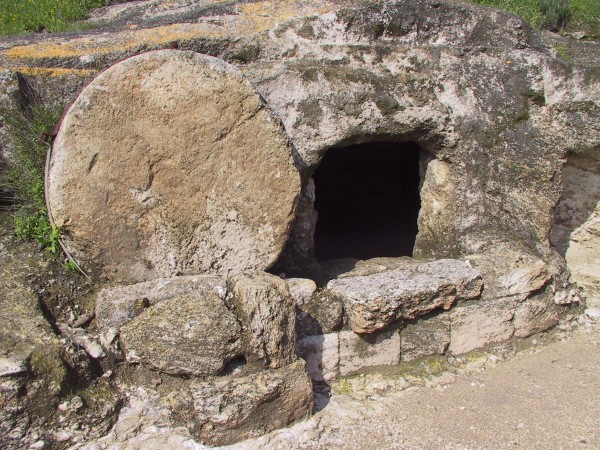
the photo below is of the tomb that Jesus once was laid in. 

Though this tomb, well outside of Jerusalem, serves as a 

great example of a first century burial place, that's all it is...

a great example.

Note the track for the stone to roll in. Some of these 

tombs had even larger stones and a steeper incline... 

making it easy to close the tomb and very difficult to open. 

The steel band, of course, was not part of the original 

and now prevents the stone from being moved.

    Joseph took the body, wrapped it in a clean 

    linen cloth, and placed it in his own new 

    tomb that he had cut out of the rock. He rolled 

    a big stone in front of the entrance to the tomb 

    and went away. (Matthew 27:59-60)

Saturday, March 07, 2009

Dead End

Sign Language: week 39


There's no coming back

Location: Sutton Hoo, Suffolk

Spotted by: Jan Chojecki

Friday, February 22, 2008

Dear Departed

Today is the first anniversary of mother's death. We thank God for her life and pray for the repose of her soul.

Praying for the Dead

Christians from the earliest centuries of the Church have expressed their communion with those who have died by praying for the dead.

Inscriptions in the Roman catacombs indicate that the early Christians honored and prayed for their deceased relatives and friends.

Tertullian (211)
Wrote that Christians offered prayer and the Eucharist for the deceased on the anniversaries of their death.

St. Augustine (354 - 430)
Neither are the souls of the pious dead separated from the Church, which even now is the Kingdom of Christ. Otherwise there would be no remembrance of them at the altar of God in the communication of the Body of Christ.

Rom 6:3-4
Or are you unaware that we who were baptized into Christ Jesus were baptized into his death? We were indeed buried with him through baptism into death, so that, just as Christ was raised from the dead by the glory of the Father, we too might live in newness of life.

Col 2:12
You were buried with him in baptism, in which you were also raised with him through faith in the power of God, who raised him from the dead.

The early Christians, in praying for their dead were expressing their belief that departed brothers and sisters underwent a purification after death ("purgatory"). Their prayers were prayers that God would have mercy on them during this time of healing and purification.

Wednesday, February 06, 2008

Triple Commemoration

Queen's Accession 1952

Almighty God. who rulest over all the kingdoms of the world, and dost order them according to thy good pleasure: We yield thee unfeigned thanks, for that thou wast pleased, as on this day, to set thy Servant our Sovereign Lady, Queen Elizabeth, upon the Throne of this Realm. Let thy wisdom be her guide, and let thine arm strengthen her; let truth and justice, holiness and righteousness, peace and charity, abound in her days; direct all her counsels and endeavours to thy glory, and the welfare of her subjects; give us grace to obey her cheerfully for conscience sake, and let her always possess the hearts of her people; let her reign be long and prosperous, and crown her with everlasting life in the world to come; through Jesus Christ our Lord. Amen.

Munich Air Disaster 1958

O Merciful God, the Father of our Lord Jesus Christ, who is the resurrection and the life; in whom whosoever believeth shall live, though he die; and whosoever liveth, and believeth in him, shall not die eternally; who also hath taught us (by his holy Apostle Saint Paul) not to be sorry, as men without hope, for them that sleep in him: We meekly beseech thee, O Father, to raise us from the death 0f sin unto the life of righteousness; that when we shall depart this life, we may rest in him, as our hope is this our bretheren do; and that, at the general Resurrection in the last day, we may be found acceptable in thy sight, and receive that blessing, which thy well-beloeved Son shall then pronounce to all that love and fear thee, saying, Come, ye blessed children of my Father, receive the kingdom prepared for you from the beginning of the world: Grant this, we beseech thee, O merciful Father, through Jesus Christ, our Mediator and Redeemer. Amen.

First Day of Lent 2008

Almighty and everlasting God, who hatest nothing that thou hast made, and dost forgive the sins of all them that are penitent: Create and make in us new and contrite hearts, that we worthily lamenting our sins, and acknowledging our wretchedness, may obtain of thee, the God of all mercy, perfect remission and forgiveness; through Jesus Christ our Lord. Amen.

N.B.

These prayers are taken from The Book of Common Prayer 1662

Friday, November 02, 2007

Praying for the Dead

Praying for the Dead

Christians from the earliest centuries of the Church have expressed their communion with those who have died by praying for the dead.

Inscriptions in the Roman catacombs indicate that the early Christians honored and prayed for their deceased relatives and friends.

Tertullian (211)
Wrote that Christians offered prayer and the Eucharist for the deceased on the anniversaries of their death.

St. Augustine (354 - 430)
Neither are the souls of the pious dead separated from the Church, which even now is the Kingdom of Christ. Otherwise there would be no remembrance of them at the altar of God in the communication of the Body of Christ.

It is not uncommon that non-believers see the Roman Catholic devotion to the Saints and the dead in general as falling under the prohibition of necrology as found in the Hebrew Scriptures. These people are not aware of the New Life of the Christian who has been called out of this life. They are not dead, but alive!

Rom 6:3-4
Or are you unaware that we who were baptized into Christ Jesus were baptized into his death? We were indeed buried with him through baptism into death, so that, just as Christ was raised from the dead by the glory of the Father, we too might live in newness of life.

Col 2:12
You were buried with him in baptism, in which you were also raised with him through faith in the power of God, who raised him from the dead.

The early Christians, in praying for their dead were expressing their belief that departed brothers and sisters underwent a purification after death ("purgatory"). Their prayers were prayers that God would have mercy on them during this time of healing and purification.

Wednesday, May 30, 2007

From beyond the grave

A website has been launched that will allow users to speak to loved ones from beyond the grave.
Messages are stored on www.leavealetter.com in complete confidence and can only be accessed by the writer. After death they can be read by intended recipients.

The site has been founded by two friends after one of them was left a comforting letter by her father after an eight year struggle with cancer. It told the daughter how much her father loved her and how proud he was of her and her family. She advised the friend's husband, who was terminally ill, to do the same for her but unfortunately he left it too late. This encouraged them to provide the service for others

Users open an account with a password that allows them to write up to eight confidential letters. A certificate with information about the site is sent to them that can be kept with their will. On their death, the recipients post or scan a copy of the death certificate to leavealetter.com. Once the death certificate is approved, they are emailed the password which allows them to read and print off the letters.

Is this a good idea? Possibly for some but not for all. What if you want to say things only to one person and never risk them coming into the public arena. For my money far better to say what you have to say to well ahead of no longer being able to say it. I am not sure I want loved ones to go into the future hanging on to a letter thinking they are hanging on to me. Rather let memory do its work as well as it can and let the bereaved move on and the departed rest in peace.

Of course, others may think differently and I am happy for them to do so.

Saturday, May 19, 2007

Online shrines

How the web is helping us deal with death
Online shrines are an increasingly popular way to mourn, finds Ed West

When Tony Blair first promised universal internet access to the nation's youth, he probably did not foresee that so many would use this bright new media forum to mourn the loss of school friends, some of them murdered by other children.
British adolescents, not always the most natural verbal communicators, have found the web to be a helpful tool
But the recent crop of horrific gang-related murders has fuelled an internet phenomenon that looks to be as big in 2007 as social networking websites were in 2006 - online shrines.
Memorial websites have existed in the United States for almost a decade, and have long been used in Israel to honour the victims of terrorism, but in Britain they have only become popular since the recent epidemic of teen-on-teen murders.
And British adolescents, not always the most natural verbal communicators, have found the web to be a helpful tool in coping with their grief.
Adam Regis, Kodjo Yenga and Billy Cox are among the tragically young faces that appear on gonetoosoon.co.uk, a non-profit website set up by Leeds bar owner Terry George.
George had originally built a memorial page in honour of a friend who died in Thailand, but it wasn't until two young men walked into his bar in tears 18 months ago that the idea for the site was really conceived.
They were both clutching an order of service for the funeral of a 20-year-old friend killed by a hit-and-run driver. George offered to set up an online memorial for the young man and the title of the order of service - Gone Too Soon - became its name.
Today, the website has more than 7,800 memorials and receives 350,000 visits a week.
There are pages dedicated to celebrities such as George Best and snooker player Paul Hunter, but the high-profile deaths of ordinary people attract the most condolences; the tribute to Ellie Lawrenson, mauled to death by her uncle's dog in Liverpool, has already received 1,500 messages.
Site manager Nicola Davis has been overwhelmed by the sudden increase in volume. "There's been a snowball effect in recent weeks, and we've had hundreds of messages of thanks from loved ones.
Sometimes we will build a page and contact the family first; sometimes, as in the case of Adam Regis, a friend will set it up." Fifteen-year-old Regis was stabbed to death in Plaistow, East London, in March and his homepage also contains a police appeal for witnesses to the attack, recognition that the internet is now regarded as the most direct way of contacting teenagers.
But as well as shining an uncomfortable light on crime among Britain's youth, the phenomenon also deals with an older British weakness.
"Bereavement in this country is done badly", says Maggie Candy, a registered nurse from Kent and founder of another memorial site alwaysberemembered.co.uk. "But people are quite good with showing emotions on the web, something they wouldn't do in real life."
Candy's quest to give people a platform for their memories was a personal one - 18 months ago her 17-year-old daughter, Stella, took her own life. Candy contacted a web developer to ask about setting up a memorial and discovered that his son had drowned at the age of seven, and that a site would be helpful for him too.
Like Gone Too Soon, their site offers well-wishers the chance to "light" an online candle in memory of the deceased. It's a ritual that echoes the Catholic tradition, but unlike in the US, religion is generally absent from British memorial sites.
"We're a nation of almost atheists," says Candy. "The meaning of religion has declined. When I started nursing, the rabbi and priests were permanently at the hospital, but these days that's very unusual."
British memorial sites are less religious shrines than online support forums, often catering for groups such as the relatives of fallen soldiers, suicides or drink-driving victims.
"Memorials for stillborn babies have become especially popular," says Davis. "People who have lost a child like to contact each other, and they will often leave messages for other sufferers."
Others log on to pay their respects to people they know only from newspaper reports, a trend that illustrates how the British way of dealing with death is changing.
For many visitors it seems to be simply as a way of showing that, despite what the Russian proverb says, the tears of strangers are not just water.


Sunday, April 22, 2007

Last aunt dies

My last aunt died last Sunday and we attend her funeral in our home village tomorrow. My wife and I now have no living relatives of our parents' generation. We are now the generation heading up the living part of our family tree which is a sobering thought. However this is only the trigger for this blog subject matter. Almost at the last moment it is announced that the aunt's funeral service will commence 15 minutes earlier than previously planned to allow time for it to take the form of a requiem mass at the suggestion of the officiating priest, entirely appropriate for a Christian lady and during Eastertide.

Requiem

The Requiem (from the Latin requiés, rest) or Requiem Mass, also known formally (in Latin) as the Missa pro defunctis or Missa defunctorum, is a
liturgical service of the Roman Catholic Church as well as the Anglican "High" Church and certain Lutheran Churches in the United States. There is also a requiem, with a wholly different ritual form and texts, that is observed in the Eastern Orthodox and Eastern Catholic Churches. The common theme of requiems is prayer for the salvation of the soul(s) of the departed, and it is used both at services immediately preceding a burial, and on occasions of more general remembrance.

The Roman Catholic Liturgy

This use of the word requiem comes from the opening words of the Introit: Requiem æternam dona eis, Domine, et lux perpetua luceat eis. (Eternal rest grant unto them, O Lord, and let perpetual light shine upon them.) The requiem Mass differs from the ordinary Mass in omitting certain joyful passages such as the Gloria, Credo, and Alleluia, and by the addition of the sequence Dies Iræ.

Anglican burial service

The Anglican Book of Common Prayer contains seven texts which are collectively known as "funeral sentences". The text of these seven sentences, from the 1662 Book of Common Prayer, is:

I am the resurrection and the life, saith the Lord: he that believeth in me, though he were dead, yet shall he live: and whosoever liveth and believeth in me shall never die.

I know that my Redeemer liveth, and that he shalt stand at the latter day upon the earth. And though after my skin worms destroy this body, yet in my flesh shall I see God: whom I shall see for myself, and mine eyes shall behold, and not another.

We brought nothing into this world, and it is certain we can carry nothing out. The Lord gave, and the Lord hath taken away; blessed be the Name of the Lord.

Man that is born of a woman hath but a short time to live, and is full of misery. He cometh up, and is cut down, like a flower; he fleeth as it were a shadow, and never continueth in one stay.

In the midst of life we are in death: of whom may we seek for succour, but of thee, O Lord, who for our sins art justly displeased? Yet, O Lord God most holy, O Lord most mighty, O holy and most merciful Saviour, deliver us not into the bitter pains of eternal death.


Thou knowest, Lord, the secrets of our hearts; shut not thy merciful ears to our prayer; but spare us, Lord most holy, O God most mighty, O holy and merciful Saviour, thou most worthy judge eternal, suffer us not, at our last hour, for any pains of death, to fall from thee.

I heard a voice from heaven, saying unto me, Write, From henceforth blessed are the dead which die in the Lord: even so saith the Spirit: for they rest from their labours.

Prayer for the dead

Wherever there is a belief in the continued existence of man's personality through and after death, religion naturally concerns itself with the relations between the living and the dead. And where the idea of a future judgment or of purgatory obtains, prayers are often offered on behalf of the dead to the Higher Powers.

Prayer for the dead is well-documented within the early Christian church, both among prominent church fathers and the Christian community in general.

The Protestant Reformation in part began as a protest against the sale of Indulgences; and by extension the Protestants, in rejecting the Roman doctrine of Purgatory, were inclined to abandon all prayers for the dead.

In the Communion Service in the
Book of Common Prayer of 1549, after praise and thanks were offered for all the saints, chiefly the Blessed Virgin, came the following: We commend into thy mercy all other thy servants, which are departed hence from us with the sign of faith and now do rest in the sleep of peace: grant unto them, we beseech thee, thy mercy and everlasting peace.

The Burial Service of the same date contained explicit prayers for the deceased, and introit, collect, epistle and gospel were provided for the Celebration of the Holy Communion when there is a Burial of the Dead. In 1552, under the influence of Bucer, all mention of the dead, whether commemorative or intercessory, was cut out of the Eucharist; the prayers in the Burial Service were brought into their present form; and the provision for Holy Communion at a Burial was omitted. The thankful commemoration of the dead in the Eucharist was restored in 1661, but prayers for them remained, if they remained at all, veiled in ambiguous phrases.

The
Church of England has never forbidden prayers for the dead, however little she has used them in her public services. It was proposed in 1552 to condemn the scholastic doctrine De precatione pro defunctis in what is now the 22nd of the Thirty-Nine Articles, but the proposal was rejected. And these intercessions have been used in private by a long list of English divines, among whom Bishop Lancelot Andrewes (c. 1600), Cosin, Thomas Ken, Charles Wesley and John Keble form an almost complete chain down to the present day. On the tomb of Bishop Barrow (1680) stands a request to passers-by to pray for their fellow-servant. And in a suit (1838) as to the lawfulness of an inscription, Pray for the soul of . . ., the court decided that no authority or canon has been pointed out by which the practice of praying for the dead has been expressly prohibited. As Jeremy Taylor put it (Dissuasive from Popery, I. I. iv.), "General prayers for the dead the Church of England never did condemn by any express articles, but left it in the middle".

Personal View

Death does not separate. It permanently unites. Love persists. Prayer is an expression of love.
Offered "through Jesus Christ, our Lord" it is simple and sound.

"May the souls of the faithful departed rest in peace and rise in glory"

"Rest eternal grant unto them O Lord and let light perpetual shine upon them"

"Holy Mary, Mother of God, pray for us sinners now and at the hour of our death"


Saturday, April 07, 2007

His Burial and mine

As a pilgrim to Jerusalem the Christian is invited to visit two locations claiming to be the burial place of our Lord. One is much more historically convincing than the other but the less authentic is very evocative.

THE HOLY SEPULCHRE

This site dates back to the 4th century, when Queen Helena decided to mark the adoption of Christianity as the official religion of her son Constantine's empire by embodying the gospel in a number of magnificent shrines. Here, outside the original city walls, local Christians told her that Jesus died and was buried, though the Roman emperor Hadrian had later incorporated the spot into his forum. Constantine's engineers dug the traditional tomb clear of its surrounding rock and covered it with a rotunda. Destroyed by the Arabs in the 11th century it was rebuilt in the 12th by the Crusaders. Today, under the dome is a little stone house, rather like a kiosk, no more than a hundred years old, covering the tomb which Constantine was at pains to isolate from the surrounding rock. Access is through a low doorway, and since there is no exit at the other end, only half a dozen pilgrims can enter at a time. A simple stone slab marks the empty tomb.

THE GARDEN TOMB

This site lies directly north of the Damascus gate in Nablus Road. It was known originally as Gordon's tomb after General Charles Gordon who was dissatisfied with Queen Helena's Holy Sepulchre Church and searched for a more sympathetic site. This first century tomb, complete with a groove for a rolling stone was uncovered in 1883. Gordon telegraphed Queen Victoria. She thanked him but added that she intended to persevere in the tradition first established 'by our cousin Helena'. There is little possibility of the site being authentic but there is equally no doubt that it is able to recreate, in a way that the Holy Sepulchre no longer can, the kind of garden setting of the tomb in which Jesus was laid.

OUR VILLAGE GRAVEYARD

The village church in my home village dates from 1234 when it was founded by the Monks of Monk Bretton. It houses and is surrounded by numerous burial places. Today the graveyard extends across the road and has expanded up to the limits of available space. It will be full sometime this year and then those needing new graves will have to travel to the next village.
Many of our family members are buried there and this is where we shall be buried as we had the foresight to purchase a plot at the time of our parents burial - and in the same area and row.

ROMANS 6.4

"We were buried therefore with him by baptism into death, so that as Christ was raised from the dead by the glory of the Father, we too might walk in newness of life."

Friday, April 06, 2007

His Death and mine

A few weeks ago I watched my mother die. This is how it should be.

The first Good Friday it was different. A mother watched her son die.

Today we all watch and wait. We watch Him die and we await our own death.

Yesterday the Iranians released into the arms of their loved ones fifteen British service persons and said it was a gesture to mark the death of Jesus. At the same time four British service persons were blown up by a roadside device manufactured by Iran in Basra, Iraq. In my book that puts the Iranians not with Jesus but with Judas and Pilate and the soldiers of Calvary. They are part of the axis of evil not saviours of the world. "Father, forgive them for they know not what they do".

The day and hour and nature of my own death are hidden from me by the kindness of a merciful God. That is fact. I cannot change it. However I can prepare for even its unexpected and early arrival by my trust in the example and power of His death for me - and for all mankind. A careful observance of Good Friday is part of that process.

Litany and Ante Communion according to the Book of Common Prayer. (8.10 a.m.)

The Three Hours preaching of the Cross. (12 noon)

Good Friday Liturgy. (3.00 p.m.)

After this I will break my fast with a cup of tea and a hot cross bun before a quiet evening and an early night.

A preacher hero of my youth called it "The pillow of the Cross" - a place of rest and letting go. That sounds like a positive approach to death whenever or however it comes.

I hope to pray - "It is accomplished" "Into thy hands I commend my spirit" as Jesus did.

Thursday, March 15, 2007

Out of the mouths of babes

I have a feeling that life in general - and blogs in particular - can sometimes seem a bit heavy and there is need to lighten things up a bit. A call for humour. Starting today I shall give up my daily blog to contributions that hopefully bring a smile to the faces of readers.

The Bible

A little boy opened the big family bible. He was fascinated as he fingered through the old pages. Suddenly, something fell out of the Bible. He picked up the object and looked at it. What he saw was an old leaf that had been pressed in between the pages "Mum, look what I've found," the boy called out. "What have you got there, dear?" With astonishment in the young boy's voice, he answered, "I think it's Adam's underwear".

Death

While walking along the path in front of his church, our vicar heard the intoning of a prayer that nearly made his collar wilt. Apparently, his 5 year old son and his friends had found a dead robin. Feeling that proper burial should be performed, they had found a small box and placed the bird inside and tied it up with string, then dug a hole and made ready for the burial of the deceased. The vicar's son was chosen to say the appropriate prayers and with great dignity intoned his version of what he thought his father always said: "Glory be to the Father, and to the Son, and into the hole he goes."

Sunday, March 04, 2007

His Transfiguration and mine

Today's gospel is
Luke 9:28 - 36 :

About eight days after this had been said, Jesus took with him Peter and John and James and went up the mountain to pray. As he prayed, the aspect of his face was changed and his clothing became brilliant as lightning. Suddenly there were two men there talking to him; they were Moses and Elijah appearing in glory, and they were speaking of his passing which he was to accomplish in Jerusalem. Peter and his companions were heavy with sleep, but they kept awake and saw his glory and the two men standing with him. As these were leaving him, Peter said to Jesus, ‘Master, it is wonderful for us to be here; so let us make three tents, one for you, one for Moses and one for Elijah’. – He did not know what he was saying. As he spoke, a cloud came and covered them with shadow; and when they went into the cloud the disciples were afraid. And a voice came from the cloud saying, ‘This is my Son, the Chosen One. Listen to him.’ And after the voice had spoken, Jesus was found alone. The disciples kept silence and, at that time, told no one what they had seen.

Bible Alive Commentary:

On a number of occasions Jesus chose to take only Peter, James and John with him. One of those occasions was the healing of Jairus' daughter; another was his last visit to Gethsemane. They were also with him when, as we read in the Gospel today, his human body was transfigured and glowed with the divine life of a glorified and resurrected body. The disciples were granted, if you like, a glimpse of heaven.

Peter, the first Pope, vividly recalled the event: "we were eyewitnesses of his majesty. For when he received honour and glory from God the Father and the voice was borne to him by the Majestic Glory, 'This is my beloved Son, with whom I am well pleased,' we heard this voice borne from heaven, for we were with him on the holy mountain" (2Peter 1.16-18).

We believe in the resurrection of the body and the soul - it is always important to be clear on this point. We believe in the hope that on the last day our bodies will rise and be resplendent and illuminated with the life of God, just as Jesus' was at the Transfiguration. What a hope! What a future! What a destiny! What kind of body it will be we don't know. Our own bodies are subject to death, decay and corruption but we live in hope of resurrection. St Paul poses the questions we all ask: "How are the dead raised? With what kind of body do they come?" There will always be an element of mystery about this - how can we know for sure what kind of body it will be?

St Paul says that there are earthly bodies and there are heavenly bodies and they both have their own beauty and splendour - however, whereas the earthly body dies, the heavenly body is not subject to corruption, and that is our hope. What we do know for sure is that just as we have borne the likeness of Jesus on earth, so in heaven we shall bear the likeness of the heavenly transfigured Jesus.

"For by the sacrifice of his own body, he did two things. He put an end to the law of death which barred our way; and he made a new beginning of life for us, by giving us hope of resurrection." (St Athanasius)

Saturday, March 03, 2007

The Woodland Trust

Yesterday's funeral and burial were pre-planned and pre-paid with a scheme which has one additional benefit namely a certificate of Woodland Planting which reads:

"This is to certify that the thoughtfulness of Ivy in purchasing this plan will be remembered for many years to come and help bring pleasure to others. Through an exclusive arrangement with the Woodland Trust, a tree has been planted in one of the Trust's woodland sites - a living legacy to enjoy. Although it is not possible to specify the type of tree or its location, a directory of Woodland Trust sites is offered with this certificate."

Detailed information about the Trust is available online at www.woodland-trust.org.uk.

The Woodland Trust is Britain's largest conservation charity. The organisation has planted over a million native and broadleaved trees such as oak,ash and beech, replacing trees lost and creating new woodland.

Over 75,000 trees have already been planted through this exclusive arrangement with the Woodland Trust.

We are spending the weekend with family in Bradford and so this afternoon, on a lovely spring day, we have tracked down and explored the two nearest sites under the protection and development of the charity. One was just under 2 acres on a hillside strip of land which provides a pleasant path from one level housing to the next level on the hillside. The other was nearer 20 acres, also on a hillside extension of a previously walled garden attached to a large house now used by another first class charity "Cheshire Homes". At both sites were "Woodland Trust" boards carrying the all important word "Welcome".

There are more than 1000 woods and wood groups in the Trust's care, covering approximately 47000 acres.


Thursday, February 22, 2007

Passion and Resurrection

Mother breathed her last earthly breath at 2.45 a.m. this morning.

May she rest in peace, and rise in glory.

She now breathes the pure air of heaven.

Thanks be to God.

Monday, January 15, 2007

Travelling in style

The Revd Ian Morris is the author of "The Motorcycle Hearse and Other Undertakings" a book about funerals which should be high on the reading priority list of all contemporary with-it clergyman. Mr Morris, a former chaplain at Addenbrooke's Hospital, Cambridge is clearly a priest who wishes his ministry to be relevant to today's people. He writes "People need permission to laugh and weep at funerals instead of the default position being sombre and serious. If there is anything that we can do to take away people's fear of death, then let's do it. A firework display or a motorcycle hearse might be exactly the right thing."

Later this month, at the very popular Christian Resources Exhibition, there will be a "Return to Sender" section which will feature the Rev Paul Sinclair, a Derbyshire Pentecostal minister, and his "Motorcycle Funerals" organisation. He can supply sidecar hearses to replace the more traditional vehicle. "Why should people who love bikes be last seen in an automobile?" he asks.

The suggestion of funeral fireworks is not simply an attempt to brighten up an otherwise gloomy procedure but a method of dispatching the ashes of the deceased into the heavens above. Thirty six such funerals have already taken place in Britain, costing between £900 and £1800 each. The professional organiser responsible tells us "people cry tears of joy at the end of our firework displays".

Then there is Vidstone. Why settle for a granite headstone when you can have one designed as a solar powered screen which shows pictures of the deceased set to music ? "Helping people to retain happy memories helps them to have closure" says the chief executive officer of this compassionate company.

On the other hand you may still want to settle for a truly Christian funeral in the context of a Requiem Mass.

The purpose of life - "to know God and enjoy him for ever"!

Thursday, December 14, 2006

Ashes to ashes, dust to dust

The funeral of a family member took place today at a local crematorium. The ashes will be scattered in a communal plot.

Many of us pre plan our funerals these days. We are aware in life of our last resting place and choose it partly with a view to posterity, I presume.

The scenario is somewhat more complex for the famous when there are expectations that future generations will wish to honour the memory.

I have followed the evangelistic career of Billy Graham since the Harringay Crusade back in the 50s. He is now 88 and his wife, Ruth, 86 and there is a debate going on in the family and beyond about their last resting place. One possibility has been described as a "tacky" tourist attraction. This would involve the couple being buried at a memorial library currently under construction in Charlotte, North Carolina, the preacher's birthplace. A friend is reported as saying "I tell you, if you're buried there I'll dig you up and move you". It seems that the barn like structure is in part the work of the former Walt Disney consultants and is meant to serve as a reminder of the preacher's childhood on a dairy farm. When completed next year, visitors will enter through a 40ft-high glass doorway in the shape of a cross and be greeted by a mechanical talking cow called Bessie. Meanwhile Ruth has the wish for burial in the mountainsof western North Carolina where she raised her children. Who wins only time will tell.

Does it matter what happens to our mortal remains? Christians have always answered "yes" to that question if the way they have honoured the relics of saints and the burial places of the faithful departed is anything to go by. If not a consecrated building then at least a consecrated plot. "We believe in the resurrection of the body" has profounded significance when unwrapped as part of our creed. This despite our sense that our true home is not here but in heaven with the Lord.

Facebook Badge

Peter Ainsworth's Facebook Profile