


Father Darren's visit to the Church of St Saviour with All Saints, Scarborough and Dulverton Hall
Jn 20:1-9
On the first day of the week,
Mary of Magdala came to the tomb early in the morning,
while it was still dark,
and saw the stone removed from the tomb.
So she ran and went to Simon Peter
and to the other disciple whom Jesus loved, and told them,
“They have taken the Lord from the tomb,
and we don’t know where they put him.”
So Peter and the other disciple went out and came to the tomb.
They both ran, but the other disciple ran faster than Peter
and arrived at the tomb first;
he bent down and saw the burial cloths there, but did not go in.
When Simon Peter arrived after him,
he went into the tomb and saw the burial cloths there,
and the cloth that had covered his head,
not with the burial cloths but rolled up in a separate place.
Then the other disciple also went in,
the one who had arrived at the tomb first,
and he saw and believed.
For they did not yet understand the Scripture
that he had to rise from the dead.
Sermon
Father Darren Smith ACS General Secretary.
He was ordained on 29th June 1986 and was the Parish Priest at Saint Luke's, Kingstanding for 17 years.
Previously he was Assistant Priest at Saint Cuthbert's, Castle Vale, Birmingham and Assistant Curate at Saint Aidan's, New Parks, Leicester.
The story of the Additional Curates Society's origins is fascinating. It speaks about the changes in society in the middle of the nineteenth century in England, as well as the significant movement in the life of the Established Church at that time. He worked in the family business at 16 Mincing Lane in the City of London and was a port importer. By 1812, he was able to retire and thereafter devote himself to good works. His achievements were considerable. He founded The National Incorporated Church Building Society which built new churches and The National Society which provided schools for the people moving to live and work in the new industrial areas.
We are in the throes of the Industrial Revolution on the one hand, and the Tractarian Movement on the other.The two are welded together in an interesting fashion by our lay founder - JOSHUA WATSON. We also reflect in our story the piety and generosity of prominent layfolk in the early eighteen hundreds. Joshua Watson was born on Ascension Day in 1771.
The Additional Curates Society was established to provide for the spiritual needs of people who were moving into the new industrial estates. The clear intention was that people in these new towns should have priests to teach the Christian Faith and minister among them providing the sacraments of the Church. Joshua was joined in his endeavours by a large number of people who shared his vision and generosity. In 1837, the subscription of £500, from King William IV, opened the fund and ACS was born.
Joshua Watson numbered among his friends major Statues in the Oxford Movement; Newman, Keble, Pusey, and he married the daughter of Father Wagner. Joshua Watson and his companions set out to put into practical effect the ideals of the Tractarian Movement by ensuring that the Christian Gospel should touch the lives of the poorest in the land. The Priesthood was seen as a precious gift from God in the mission of the Church. The "apostolical succession" was important and from the beginning to this day ACS has insisted that grants be given only to priests licensed by the bishop and resident in the parish.
In the early days grants were used to pay the stipend of the assistant curate - often in full. As the Church assumed responsibility for paying the stipend of a curate, ACS assisted in paying for housing, and more recently grants have been applied to help defray the cost to the parish of employing an assistant priest. Today the Church faces a new situation and new uncertainties. The great financial losses experienced by the Church Commissioners means that parishes are being faced with new financial burdens. The ACS will seek to relieve these burdens, particularly in the least affluent parishes of the land where these hardships will be most felt. Without doubt, many parishes would never be able to contemplate employing an assistant priest without assistance from ACS. Diocesan Bishops have always been pleased to call on ACS to enable them to place
curates in parishes needing financial help.
ACS has always sought to respond with generosity. Any parish may apply to ACS for a grant for an assistant priest. Grants are assessed by the Council and awarded on the grounds of the parishes' financial needs and the number of people living in the parish. The size of a grant is determined by the income of the parish and the amount of money available at the time of the application. The Council meets quarterly to consider new grants. Grants are awarded for the duration of the curacy. Grants are paid retrospectively and cease when the curate moves on to another parish. A new application has to be made by the parish when a new assistant priest is employed.

 | ||||
DELIA'S LENT REFLECTIONS John 20:9 Then the other disciple who had reached the tomb first also went in; he saw and he believed. | ||||
| ||||
Photo: Paul Smith, Colombia Up at 5.00 a.m. sat in the dark awaiting dawn over the Scarborough sea. Too overcast to see sun rise but knew it happened because light broke through and gradually flooded the world outside and the room inside. By 6.00 a.m. day break was complete. | ||||
The Tomb of Jesus Question: The tomb where Jesus was buried... Where is it? What does it look like? Is there a picture of the tomb? Can you visit the burial site of Jesus? Answer: It would be really nice if I could tell you that the photo below is of the tomb that Jesus once was laid in. Though this tomb, well outside of Jerusalem, serves as a great example of a first century burial place, that's all it is... a great example. |
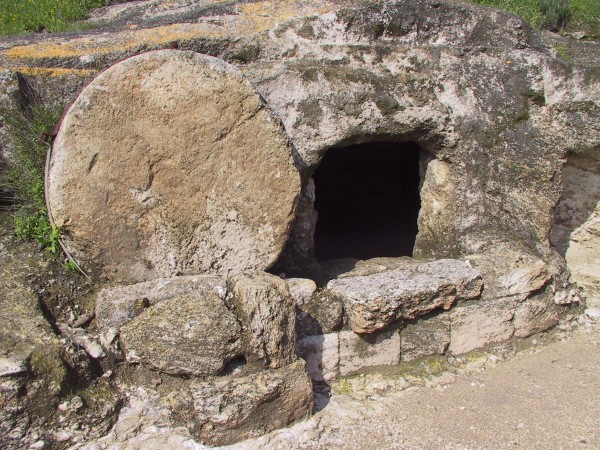
Note the track for the stone to roll in. Some of these tombs had even larger stones and a steeper incline... making it easy to close the tomb and very difficult to open. The steel band, of course, was not part of the original and now prevents the stone from being moved. Joseph took the body, wrapped it in a clean linen cloth, and placed it in his own new tomb that he had cut out of the rock. He rolled a big stone in front of the entrance to the tomb and went away. (Matthew 27:59-60) |
Since Ash Wednesday, when Lent began, we have been preparing for Easter. But Lent, as many believe, doesn't end on Easter Sunday. It ends when the Easter Triduum begins - on Holy Thursday. The Triduum encompasses the three days - Holy Thursday, Good Friday and Easter Vigil/Easter Sunday - when we celebration the death and resurrection of our Lord, Jesus Christ.
On Holy Thursday we remember the Last Supper. Jesus gives us the Sacrament of the Eucharist…
Then he took the bread, said the blessing, broke it, and gave it to them, saying, "This is my body, which will be given for you; do this in memory of me." And likewise the cup after they had eaten, saying, "This cup is the new covenant in my blood, which will be shed for you. (Luke 22:19-20)
Jesus then washes the feet of his disciples as an example of the service to which we are all called. At the Holy Thursday Mass the presider, and oftentimes other members of the parish, wash the feet of all those present who wish to participate.
The only Masses celebrated on Holy Thursday are in the evening. No daytime masses are scheduled anywhere within our universal church except the evening mass, which marks the beginning of the Easter Triduum.
On Good Friday we remember the passion and death of Jesus Christ. It is a day of fasting and abstinence. There are a variety of services held on Good Friday, from the solemn Liturgy of Good Friday - where the Passion of Christ is proclaimed and the opportunity to venerate the cross given - to the Living Stations of the Cross. My parish has a Tenebrae service that is one of the most powerful Good Friday services I've ever experienced. Tenebrae is Latin for "darkness" or "shadows" and its purpose is to recreate the emotional aspects of the passion story through narration, meditation, prayer and song. With the telling of the story and the seven words Jesus spoke from the cross, candles are extinguished; one at a time after each time Jesus speaks from the cross until all candles are out and the church is in darkness. Then a loud noise is made to symbolize the earthquake at the time of his death. All leave in quiet and darkness. The light of Christ doesn't burn again until the Easter Vigil.
Easter Vigil is when we proclaim with fire and song that Jesus Christ, our Lord, has risen. The Vigil Mass is long, but is one of the most amazing Masses of the year - at least in my experience. Easter Vigil is when we welcome many who have been preparing to enter the Catholic Church into full communion with us.
Easter Sunday is just part of the story. To experience the fullness of the Easter story - the Easter Triduum - the passion, death and resurrection of our Lord, give yourself the awesome gift of attending the Mass of the Lord's Supper on Holy Thursday, a service on Good Friday and either the Easter Vigil or Easter Sunday Mass.


